 Skip to content
Thurje Handmade · Albanian Weaving Heritage
The thread predates the printing press.
In Albania, by centuries.
Albanian weaving is not a romantic tradition recovered from the edge of disappearance. It is a continuous practice — documented across every region of the country, in eight distinct local variants, using five different techniques that evolved independently of each other over hundreds of years. Thurje does not preserve this. We are proudly part of it.
8
Regional variants documented across Albania
5
Distinct weaving techniques, each with its own geography
Mat
Site of oldest known Albanian wool textile — petrified in excavation
Korçë
Most technically advanced variant — Thurje’s home
"In every Albanian house that has kept faithfully the old traditions of folk culture, the first thing that strikes the visitor and draws the most attention is the magnificent appearance of the guest room."
— Ikbal Mustafa Bihiku, Qilima Shqiptarë, Tirana, 1960
Source: Ikbal Mustafa Bihiku, “Qilima Shqiptare / Tapis albanais / The Albanian Carpets” — Universiteti Shtetëror i Tiranës, Instituti i Historisë e Gjuhësisë, Sektori i Etnografisë, Tirana, 1960. The first systematic study of Albanian rugs. All regional data, technique classifications, and historical evidence on this page draw from this primary source.
— Archaeological evidence — the oldest textile
“Archaeological excavations at Mat revealed fragments of petrified wool textiles, worked with considerable distinction — evidence that weaving was practiced in this territory in antiquity.”
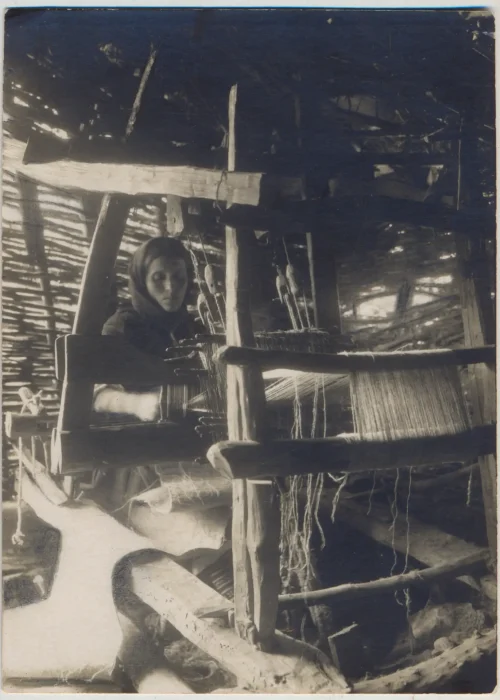
— woman weaving on a floor loom · photo from the beginning of 20th century
· credits · Drejtoria e Përgjithshme e Arkivave
— The first scholarly record
The first systematic collection and study of Albanian rugs was published in 1960 by Ikbal Mustafa Bihiku, painter and researcher at the Ethnography Sector of the Institute of History and Linguistics, State University of Tirana. The book — Qilima Shqiptare / Tapis albanais / The Albanian Carpets — was published in three languages simultaneously, signaling from the outset that this was not a local document but an international cultural record. This was, as Bihiku noted herself, the first time this material had received a dedicated publication despite the tradition’s breadth and age. Materials came partly from the Sector’s archive and partly from her own expeditions across the country.
The study classified Albanian rugs into their regional variants for the first time, documented the five distinct weaving techniques, traced the evolution of production tools across five stages, and established the connection between sleeping mats and room rugs. It is the primary source for everything Thurje claims about Albanian weaving heritage.
— From sleeping mat to guest room anchor
“The objects used today for sitting were once used for sleeping. From sleeping objects evolved the distinct coverings for laying out entire rooms.”
The ethnographic record establishes a specific and surprising origin for the Albanian room rug: it evolved directly from the sleeping mat. Before the Ottoman period introduced the guest room culture and floor-sitting tradition, Albanian families slept and rested on individual woven mats approximately 1×1.8 metres — the size of a single person lying down. Evidence of this persists: in the Has and Luma regions even in the ethnographer’s time, the same woven piece served both as sleeping mat and sitting surface, folded to the edge of the room when guests arrived.
The Ottoman arrival introduced floor-sitting culture broadly across Albanian urban areas — and with it, the need for larger, room-scale rugs. But the ethnographic record is explicit: this changed the scale and cultural role of Albanian weaving, not its existence. In the highland regions where Ottoman influence was weakest — Malësia e Madhe, Dukagjin, Nikaj-Mertür, Mirditë — traditional stone-bench seating persisted longest, and these are also the regions where the most archaic rug forms survived as “remnants of a distant past.”

— woman with spinning tool · photo from the beginning of 20th century
· credits · Drejtoria e Përgjithshme e Arkivave
T1
Straight weave
used across all regions · foundational technique
The weft thread passes alternately over and under each warp thread across the full width of the piece. The most primitive and most widespread form.
“With this technique the earliest forms of Albanian rugs appear — the foundation layer beneath all subsequent development.”
T2
Skip weave
Malësia e Tiranës · used in combination
The weft thread skips over 2, 3, or 4 warp threads at intervals rather than passing over each one. This breaks the uniform horizontal line and allows partial surface patterns — but only produces a single usable face.
“This technique breaks the monotony of uniform horizontal lines — the first step toward free movement across the surface.”
T3
Return weave
Korça · Luma · Dibra · Malësia e Tiranës
The weft thread passes alternately over and under each warp thread across the full width of the piece. The most primitive and most widespread form.
“With this technique it became possible to express every motif from the simplest to the most complex — the full artistic vocabulary of the Albanian rug became available.”
T4
Application technique
Has · Zadrima
Once off the loom, large geometric motifs are hand-embroidered over the surface using a filling stitch in black wool. The decoration is applied after the structural weaving is complete — not woven in.
“The Has rug circumvents the vertical movement problem entirely — by applying the decoration separately from the weaving, the maker achieves complete freedom of placement.”
T5
Pile weave
Luma · Labëria · coastal plains
A knotted pile fiber is tied onto every two weft threads, cut to approximately 1cm length. Known commercially as the Persian technique — but in Luma it has an independent and fully developed regional tradition.
“The dense, short pile of the Luma saxhade — one pile fiber for every two weft threads — gives a surface unlike anything else in Albanian textile production.”
In Thurje's workshop
T1 · T3 · T4
Thurje works in the Korça tradition using the straight and return weaving techniques. The application technique has been used in particular projects and collections.